Equipment Buying Guide
How to Specify an Industrial Frying Production Line
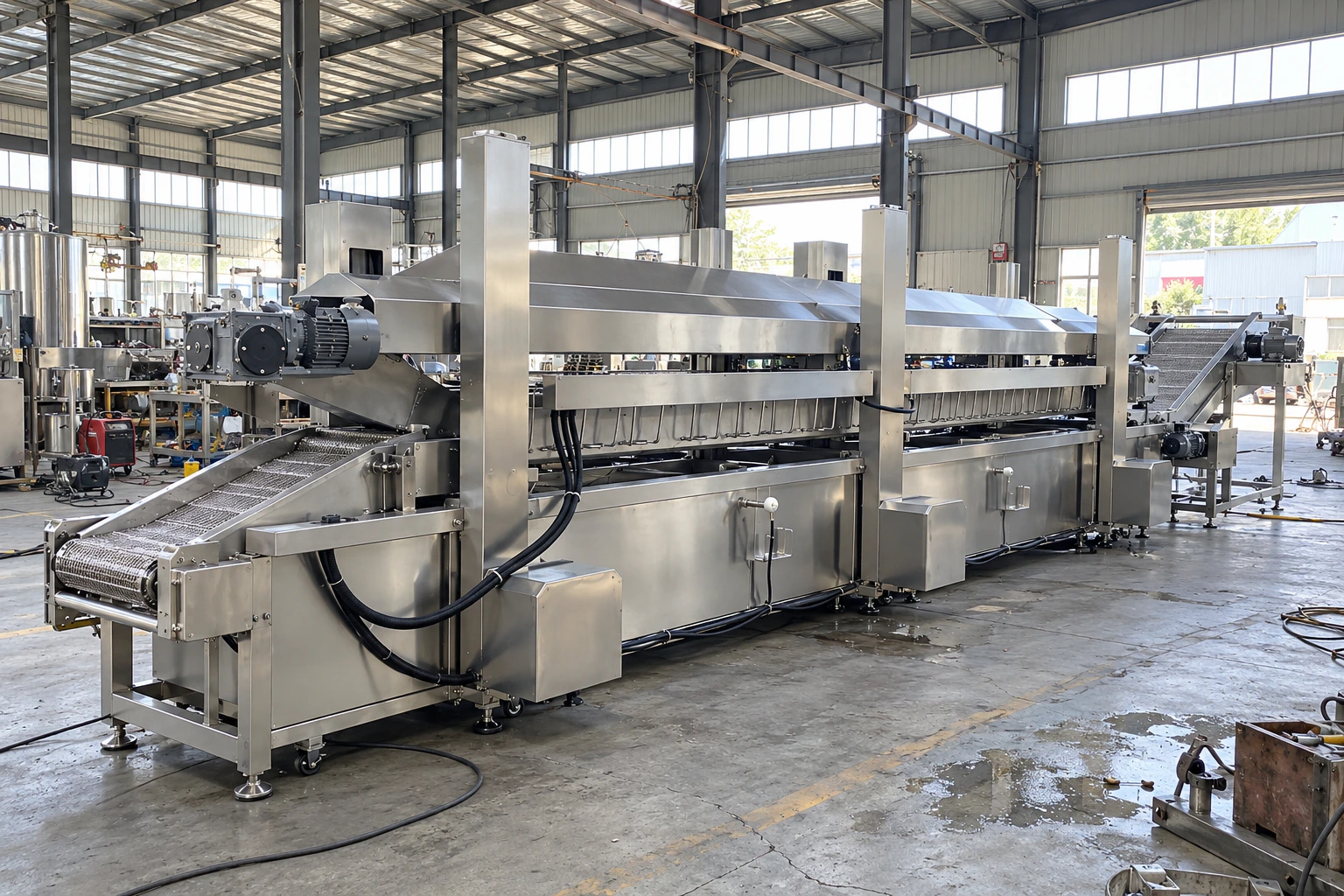
A fryer is only one part of the line. Reliable selection begins with the food, preparation condition, required finished output and quality target, then connects feeding, frying, oil handling, de-oiling, cooling, seasoning, cleaning, utilities and acceptance evidence into one project scope.
Direct Answer
Specify an industrial frying production line from the product outward. Give suppliers the raw material and coating condition, incoming temperature and moisture, product dimensions and buoyancy, finished-output target, frying time and color endpoint, acceptable oil pickup, production schedule, available heat source, factory utilities, cleaning method and downstream process. Ask every supplier to test representative samples and quote the same line boundary, oil-management scope and acceptance criteria. A model name or headline kilograms-per-hour figure is not enough to select a reliable line.
Start with the fried product, not the fryer model
An industrial frying production line cannot be selected responsibly from the words chicken, potato or snack alone. A breaded nugget, an uncoated meatball, a wet vegetable slice and an expanded pellet place different demands on feeding, oil circulation, residue removal, belt design and downstream handling. Even two products with the same name can behave differently when size, recipe, coating or incoming temperature changes.
Describe each product that will run on the line. Record typical and maximum dimensions, piece weight, incoming temperature, surface moisture, coating type and pickup, density or buoyancy, fragility, target color, texture and whether frying completes cooking or only sets the surface before another thermal step. Include photographs and a sample specification when available.
If several products share one line, list their production ratio and changeover schedule. The most difficult product may determine belt arrangement, filtration and cleaning access, while the most frequent product may determine the most economical operating point. This product matrix is more useful than asking a supplier for one universal automatic fryer.
Question 1: Is the process batch or continuous?
Batch frying loads, cooks and discharges a defined quantity at a time. It can suit frequent recipe changes, specialty products, short campaigns and projects where operators need direct control over individual batches. A continuous fryer moves a controlled product bed through heated oil and is normally evaluated with steady feeding, residence-time control and connected discharge equipment.
Continuous does not automatically mean better. A stable, repeated product and production schedule can justify a connected line, while many small orders with different temperatures or frying times may create excessive changeover and oil-management work. Conversely, a batch system may become labor-intensive or inconsistent when a factory needs long runs at a steady output.
State run length, products per shift, changeover frequency, operator availability and required traceability. If uncertainty remains, ask the supplier to compare both process modes using the same finished-output target and the same upstream and downstream scope. LACA also lists a tilting basket fryer separately because it is a different production method, not a smaller version of every continuous line.
Question 2: What equipment belongs inside the line boundary?
The fryer body is not the full project. A practical line may include product preparation, metered infeed, a spreader, battering or breading, transfer conveyors, the fryer, oil circulation and heating, coarse and fine residue removal, make-up oil, de-oiling, cooling, seasoning, inspection and a connection to freezing or packaging. Some products need blanching or surface drying before frying; others need forming and coating.
Draw the process from the last confirmed upstream condition to the first confirmed downstream condition. Mark which supplier provides every conveyor, pump, platform, tank, hood, exhaust connection, filter and control interface. Define responsibility for product transfers because a short uncontrolled drop can damage coating or create an uneven fryer bed.
Ask for one layout and one equipment list carrying the same item numbers. A quotation that says complete line while omitting oil storage, cooling, exhaust treatment or discharge handling is not directly comparable with a genuinely integrated offer. Any boundary left open should be stated as a buyer-supplied interface with dimensions and utility requirements.
Question 3: How is required capacity defined?
Capacity must identify what is weighed and when. Incoming wet product, coated product entering the fryer and finished product leaving after moisture loss are different mass bases. State whether the target is kilograms per hour of feed, fried output, saleable output after cooling, or total tonnes per shift after planned cleaning and changeovers.
Continuous fryer size relates to production rate, frying time and allowable belt loading. A long residence time, fragile single-layer product or low permissible bed depth can require more effective cooking area than a short-fry product carried in a deeper bed. Product width and flotation behavior also affect usable belt width and the need for a hold-down belt or guided flow.
Ask suppliers to show the calculation basis without demanding proprietary design details. The offer should state assumed feed condition, target residence time, usable belt width, bed depth or pieces per area, operating hours and expected finished-output basis. Treat an unsupported nameplate capacity as a sales number until a representative run demonstrates it.
Question 4: How will the product enter, travel and leave the oil?
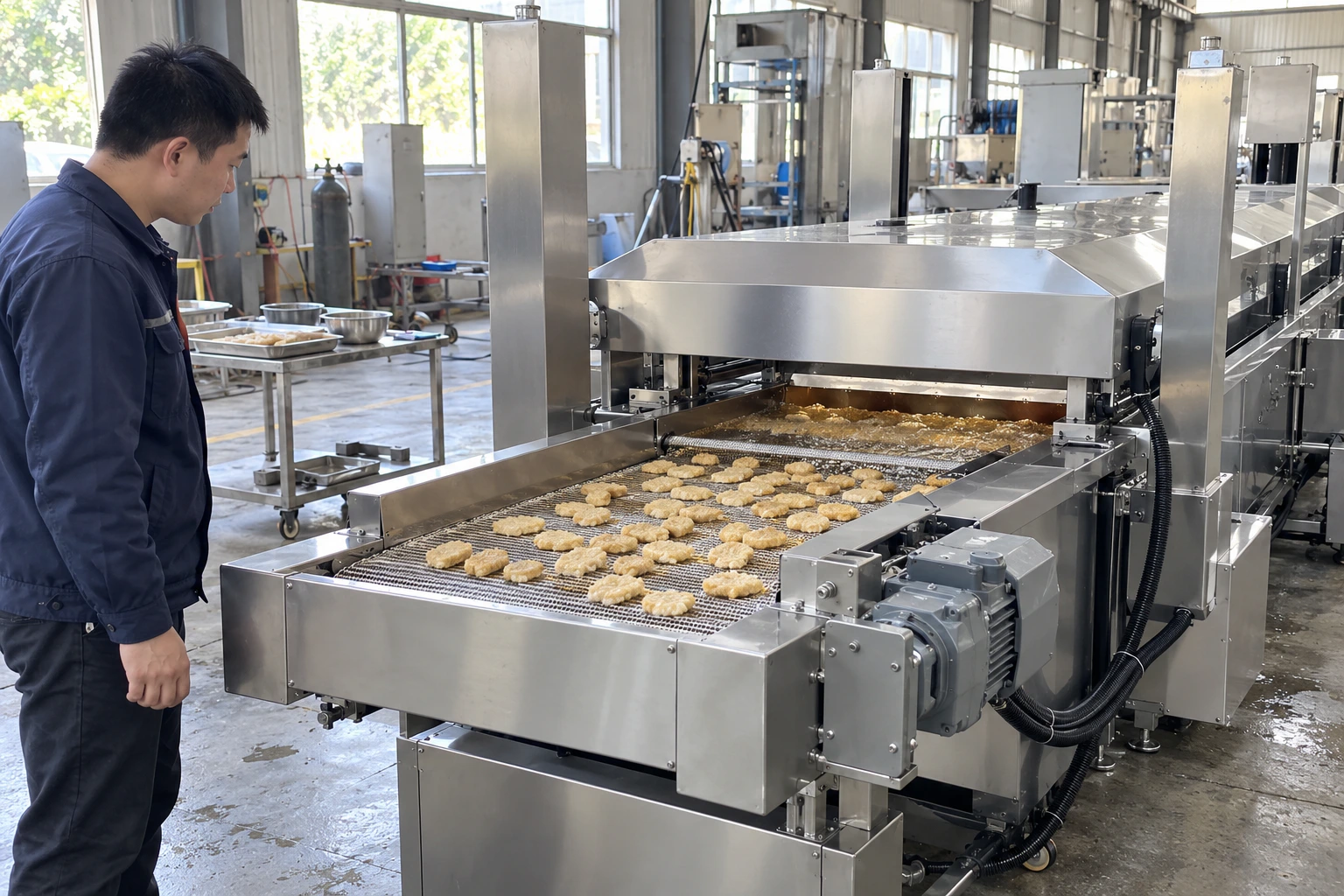
Product handling inside the fryer affects color, coating integrity and residence-time consistency. Floating products may need controlled submersion or an upper belt. Products that sink need a bottom conveying arrangement that prevents accumulation. Some foods change buoyancy during frying, so the correct solution may use staged belts, paddles or zones rather than one fixed mesh.
The infeed should create an even product bed across the working width. Clumps, overlapping pieces and surges change the heat load and prevent pieces from receiving the same process. Wet or fragile products may need a short, gentle transfer; coated foods need handling that minimizes coating loss before it is set.
At discharge, define drainage time, drop height and the next process. A fragile snack may need a shallow transfer to a de-oiling conveyor, while a prepared food may connect to cooling or freezing. Review jam points, belt release, side guides and the method used to recover product safely during a stop.
Question 5: What oil-management system is included?
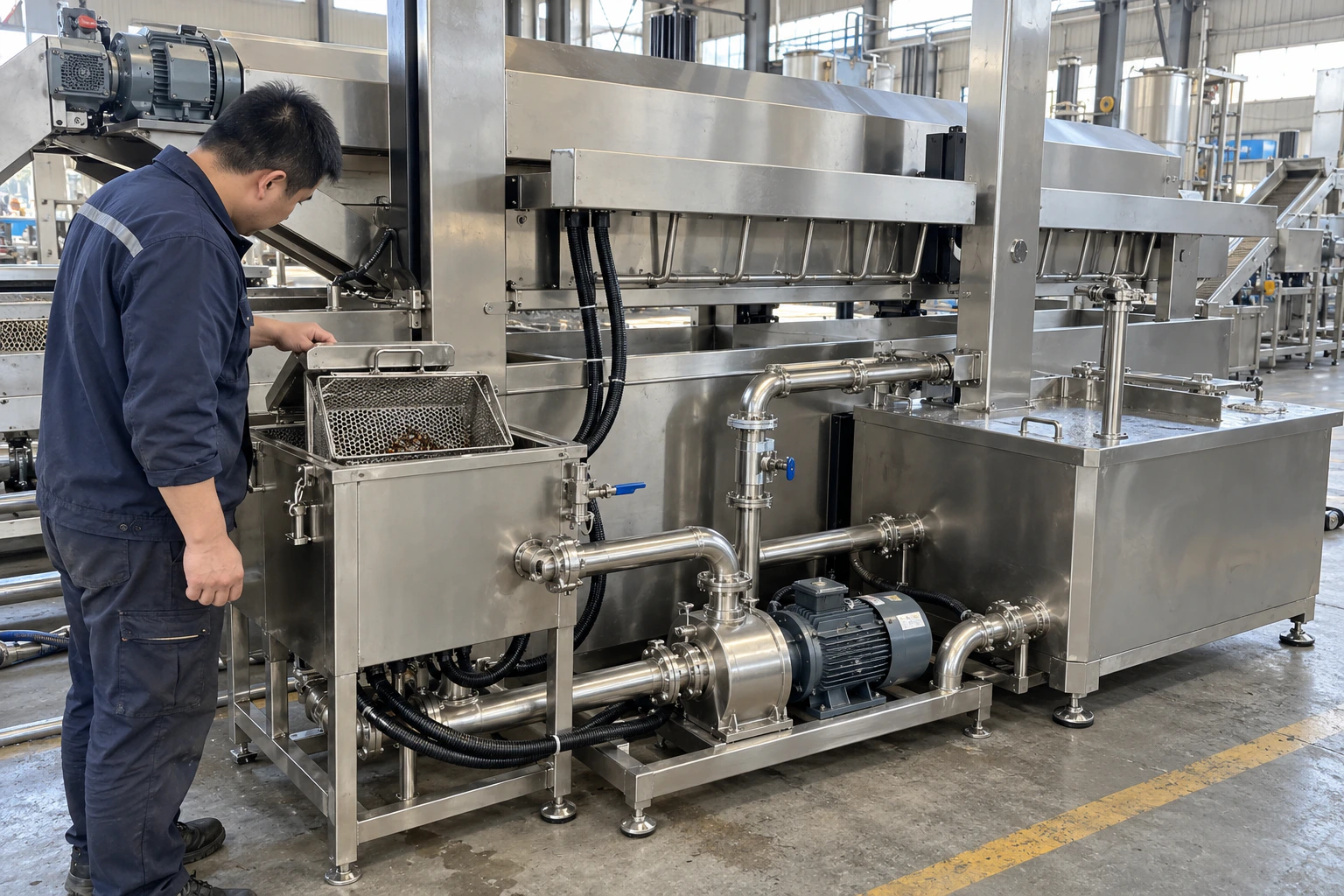
Cooking oil is both a heat-transfer medium and an ingredient carried into the finished product. Its condition changes with temperature, oxygen exposure, water released from food, crumbs, coating fines, metals, idle time and the rate at which fresh oil enters with production. For that reason, filtration cannot be selected as a decorative option after the fryer is sized.
Describe the residue generated by the actual product. Coarse floating pieces, sinking particles, fine batter dust and sticky seasoning contamination require different removal methods. Ask how the system moves debris away from hot zones, which filter stages are continuous, what is removed during production and what remains for end-of-run cleaning.
The quotation should show the working oil circuit: fryer pan, outlets, screens or filters, pump, heat source or exchanger, return points, make-up arrangement, holding tank and safe cooling or draining route. Confirm oil volume, access to filter media, disposal of captured solids, protection against low oil level and the method used to avoid long hot idle periods.
Question 6: Can heating recover from the real moisture load?
When cold or wet product enters, oil temperature falls because energy is used to heat the food and evaporate water. A display setpoint does not prove that the product experiences a stable process. The heating system, oil flow and control response must manage the expected load without creating excessive hot spots or slow recovery.
Give the supplier the incoming product temperature, surface water, coating or batter load, feed rate and expected process interruptions. State the available heat source, fuel quality, electrical supply or thermal-oil conditions. Direct electric, gas, LPG, diesel or other arrangements have different installation, exhaust, control and maintenance implications; the correct choice depends on the site and project configuration.
Ask for the proposed operating temperature range, control points, alarm logic and response to a feed stop. Do not convert a catalog temperature range into a product recipe. Final frying temperature and time must be established through trials and the processor's validated quality and food-safety program.
Question 7: How are residence time and product quality verified?
Residence time in a conveyor fryer is influenced by effective oil-path length and belt speed, but the product may also move relative to the belt through buoyancy, oil flow or mechanical guidance. A nominal one-to-five-minute adjustment range does not guarantee that every piece receives the same process. Distribution across the belt and the condition at start-up and shutdown also matter.
Define measurable endpoints before the test: color range, core temperature where applicable, moisture, coating adhesion, texture, breakage, product weight change and surface-oil result. For plant-based starchy foods, time and temperature also interact with process contaminants such as acrylamide, so the processor should establish an appropriate mitigation and verification plan for the actual recipe and market.
During a trial, record feed rate, product temperature, oil temperature at agreed locations, belt speed, oil level, observations of flow and the finished results over time. Keep samples from the beginning, stable middle and end of the run. A good test shows process stability, not only one attractive sample selected from the discharge.
Question 8: What must happen before frying?
Upstream preparation often decides whether the fryer can run steadily. Potato or vegetable products may require washing, cutting, blanching and surface-water removal. Formed foods may require stable dimensions and temperature. Breaded products depend on controlled predust, batter viscosity, crumb application and sufficient transfer support before the coating is set.
Excess free water raises the heat load and increases oil disturbance. Variable piece size creates mixed residence-time needs. Loose coating becomes a filtration burden and can burn if it remains in hot zones. These issues cannot be corrected only by increasing fryer temperature or slowing the belt.
Specify the exact product condition at the fryer infeed and identify who supplies the upstream controls. If coating is part of the project, review the LACA battering and breading machine as a separate process step and confirm belt width, line speed and transfer height against the fryer.
Question 9: What happens immediately after frying?
The product leaving the oil is still changing. Surface oil drains, heat continues to move inward, steam escapes and fragile coatings can be damaged by handling. The discharge arrangement therefore belongs in the process design, not only in the factory layout.
Define the required de-oiling method and the time available before seasoning, cooling, freezing or packaging. Vibratory drainage, air stripping, centrifugal removal or a simple drain conveyor suit different foods and capacities. The supplier should explain how recovered oil returns to the managed system and how crumbs are prevented from reaching the next process.
Seasoning pickup depends on product temperature and surface condition, while packaging depends on adequate cooling and moisture control. Ask for the target product condition at each handoff. A balanced line avoids a high-capacity fryer discharging into an undersized de-oiler, cooler or freezer.
Question 10: Can operators clean and inspect the fryer safely?
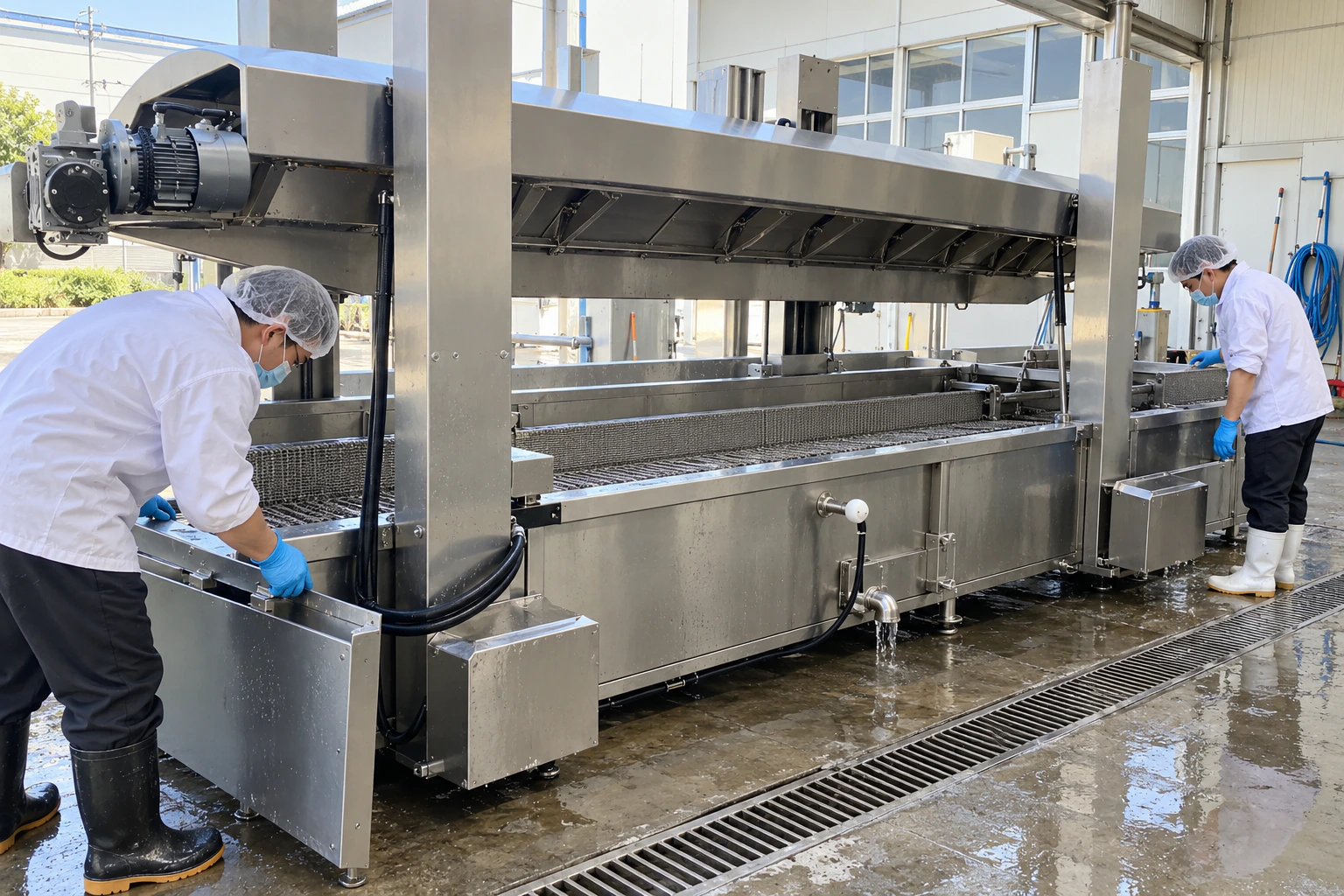
Sanitation time reduces the hours available for production, so access should be evaluated as part of capacity. Review hood lifting, belt lifting or removal, drain points, dead zones, filter access, removable screens and the route used to move parts to washing. Confirm which surfaces are food-contact and which electrical or insulated areas cannot be sprayed.
Ask the supplier to demonstrate the complete shutdown and cleaning sequence with the system safely cooled and isolated. Time oil transfer, cooling, gross residue removal, opening, belt and pan cleaning, inspection, reassembly and restart preparation. Check whether operators need lifting aids or special tools for heavy parts.
The plant remains responsible for its sanitation program, chemicals, verification and safe working procedures. Equipment claims such as easy cleaning should be converted into observable features and a witnessed cleaning test. Stainless-steel appearance alone does not show that residue can drain or every surface can be inspected.
Question 11: Do the utilities, exhaust and safety systems fit the factory?
Provide destination voltage, frequency and phase; available electrical capacity; fuel or thermal-oil data; compressed air; water temperature and pressure; drainage; ventilation and wastewater constraints. Identify who provides field piping, ductwork, foundations, platforms, fire protection, cable trays and final connections.
Frying releases heat, water vapor, oil mist and odors. Heating equipment may also create combustion exhaust. The project team should involve qualified local specialists to size ventilation, evaluate emissions and establish fire-safety measures for the destination. A machine supplier's standard hood does not by itself prove compliance with the installed building.
Review low-oil-level protection, over-temperature response, pump and belt interlocks, hood-lift protection, emergency stops, guards and the controlled response to loss of power or product feed. Ask for a cause-and-effect description so operators know what stops, what keeps cooling or circulating and how trapped product is handled.
Question 12: Does the layout support operation and maintenance?
A line layout should show more than machine footprints. Add operator positions, ingredient and oil routes, clean and dirty part movement, maintenance pull space, filter-media handling, waste collection, floor drains, platforms, ventilation ducts, control cabinets and the path used to replace motors or belts.
Confirm infeed and discharge elevations, process direction, service side and access around every valve and panel. Overseas projects should also check door openings, container unloading, lifting points and the route from the receiving area to the final installation position. A correctly sized fryer can still be impossible to install if these constraints are discovered after shipment.
Ask for a utility and interface drawing before approval. Mark buyer and supplier responsibilities directly on it. If future expansion is expected, reserve the floor space, electrical capacity, oil-handling connection and control interfaces instead of assuming a larger machine can be added without modifying the original line.
Run a representative trial and factory acceptance test
Send enough normal product to test start-up, steady production and shutdown. Record recipe, dimensions, temperature, coating, surface moisture and storage history. Agree which settings may change and who judges the finished result. When shipping samples is impractical, define a staged plan using local trials, video evidence and later site validation without presenting an untested result as guaranteed.
A factory acceptance test should verify machine identity, guards, controls, interlocks, belt movement, oil-circuit operation, heating response, alarms, included accessories and documentation. A product run should separately evaluate feeding, throughput basis, process stability, finished quality, residue behavior, de-oiling and cleaning. The test conditions and instruments should be written in advance.
Record open points with owners and deadlines. The final offer and purchase order should reference the tested or agreed configuration, layout revision, utility list, spare parts, manuals, packing, commissioning and site acceptance. This evidence is more valuable than a video that shows the machine running without measured inputs or outputs.
Compare quotations on one technical scope sheet
Normalize every proposal before ranking price. Separate the fryer body from required preparation, conveyors, oil management, heating, exhaust, de-oiling, cooling, seasoning, platforms, controls, spares, packing and commissioning. Mark all performance values that still depend on product trials.
Use the same units, production basis and destination conditions. An offer based on wet feed kilograms per hour is not directly comparable with one based on saleable fried output. Likewise, a low equipment price may exclude filters, oil tanks, ventilation or installation work that the plant must still purchase.
| Comparison item | What the buyer should specify | Evidence to request |
|---|---|---|
| Product duty | Products, size, temperature, moisture, coating, buoyancy and quality targets | Approved product matrix and representative test record |
| Capacity basis | Feed and finished-output basis, run hours, changeovers and belt loading | Calculation assumptions and stable-run data |
| Frying process | Time, temperature range, heating source, belt and immersion method | Process description, layout and recorded trial settings |
| Oil management | Residue load, filtration stages, oil volume, make-up and storage | Oil-flow diagram and included equipment list |
| Cleaning and safety | Shutdown, cooling, access, drainage, interlocks and sanitation method | Cleaning demonstration and cause-and-effect test |
| Project delivery | Utilities, interfaces, packing, installation, training and acceptance | Responsibility matrix, document register and commercial schedule |
Send a useful RFQ instead of asking only for a price
Begin the RFQ with the product and business target. Include photographs, formulation category, incoming condition, dimensions, coating, target fried result, throughput basis, hours per shift, products per day and changeover frequency. State whether representative samples can be tested and which measurements define acceptance.
Add the factory conditions: destination, voltage, available heat source, utilities, room dimensions, process direction, ventilation and drainage plan, upstream and downstream machines and preferred automation. Request a layout, equipment list, utility list, oil-flow description, cleaning method, spare-parts quotation, delivery terms and installation responsibilities.
Use the LACA continuous frying production line page as the technical starting point, then send the project data through the contact page. The current XDL catalog references several belt widths, heating options and adjustable residence time, but rated power, oil volume, usable frying length, filtration duty and finished output remain project-specific and must be confirmed for the actual food.
The right line is the one that proves the complete process
A reliable industrial frying production line balances preparation, feeding, heat delivery, residence time, oil condition, product handling, de-oiling, downstream capacity, sanitation and factory utilities. Optimizing one component while ignoring the others creates bottlenecks and quality drift.
Make the purchase decision in sequence: define products and endpoints; choose the production mode; establish the capacity basis; map the line boundary; verify belt and oil behavior; match heating and filtration to the load; test cleaning and safety; complete the layout; and attach measurable acceptance criteria. This turns an equipment inquiry into a controlled engineering discussion.
Do not ask a supplier to guarantee an unknown recipe. Ask the supplier to state assumptions, run representative evidence and document open conditions. That approach gives both buyer and manufacturer a clearer route from quotation through commissioning and future production.
Frequently Asked Questions
What information is needed to quote an industrial frying production line?
Provide the food and recipe category, size, incoming temperature and moisture, coating, buoyancy, target fried result, feed and finished-output capacity, frying time, production schedule, heat source, utilities, layout, downstream process, destination and sample availability.
Should I choose a batch fryer or a continuous frying line?
Choose from the production pattern rather than capacity alone. Batch systems can suit short campaigns and frequent changes; continuous lines suit stable products and repeated runs when feeding, oil management and downstream equipment can operate as one balanced process.
How is continuous fryer capacity calculated?
Capacity depends on the stated mass basis, frying time, usable belt area, allowable belt loading, product dimensions, buoyancy, moisture load and heat recovery. Confirm the assumptions through a representative product run.
Why is oil filtration important in an industrial fryer?
Product crumbs and coating fines can remain in hot oil, carbonize and affect oil and finished-product quality. Filtration and residue removal should match particle size, quantity and whether debris floats, sinks or stays suspended.
Which heating method is best for a frying production line?
There is no universal best method. Electricity, gas, LPG, diesel, thermal oil or another project-specific option must be compared against local utilities, heat load, control response, ventilation, maintenance and operating cost.
How should buyers test a continuous frying line before shipment?
Agree a factory acceptance plan covering machine identity, controls, interlocks, oil circulation, heating, alarms and documents, then run representative product while recording feed condition, throughput basis, temperatures, belt speed, product quality, de-oiling and cleaning.
Continue Your Research
Tell LACA about your project
Share your material, required output, capacity, destination and any project details available. LACA will use them to begin a focused equipment discussion.