Thermal Processing
Start a Retort Project with the Product and Package
Retort selection begins with the food and its sealed container. Package geometry, fill, residual gas, orientation and basket arrangement affect heat transfer, handling, capacity and pressure control, while the scheduled thermal process remains product- and package-specific.
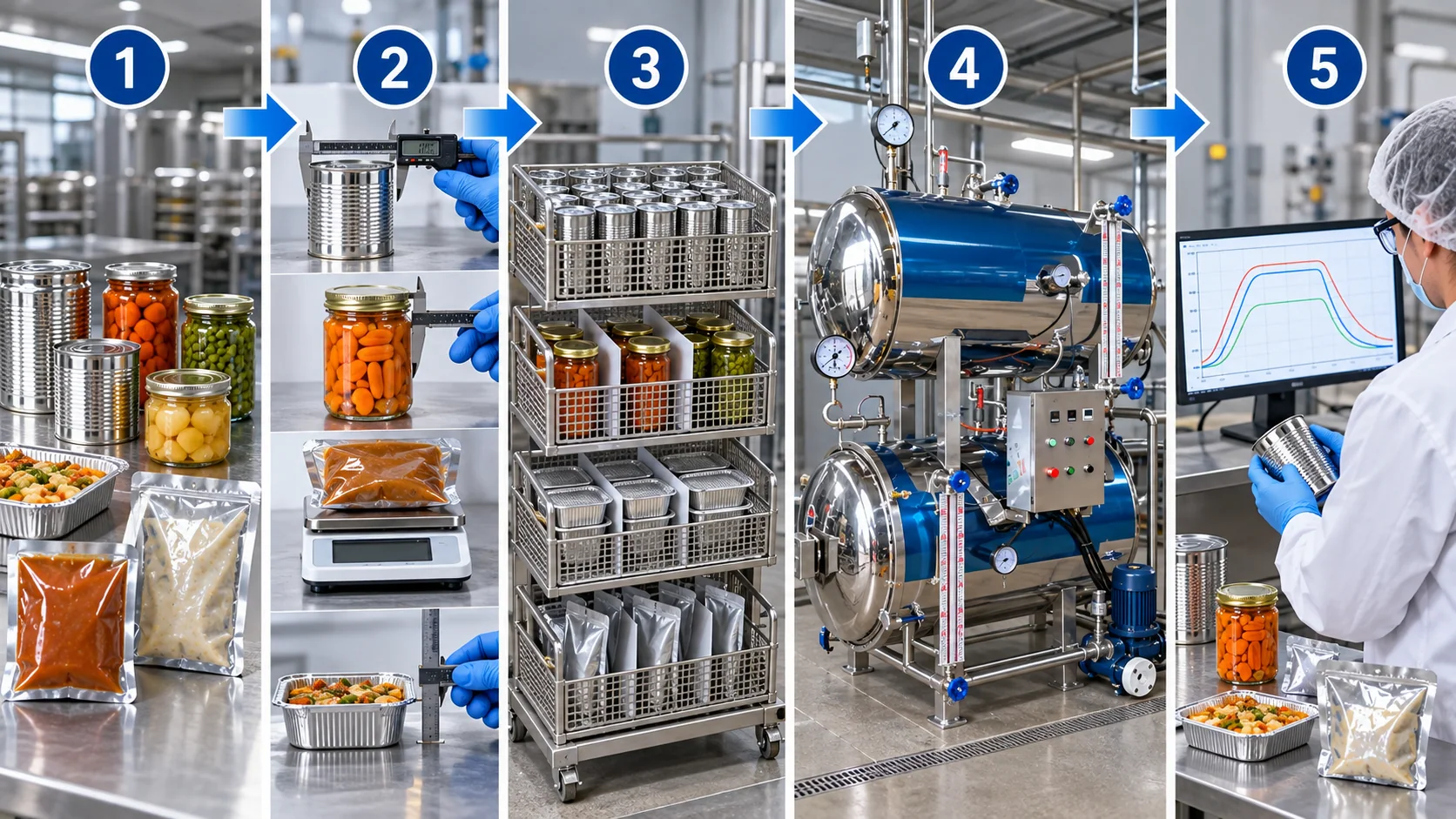
Direct Answer
Before requesting a retort, define the food formulation and physical behavior, package type and construction, dimensions, fill weight, headspace or residual gas, closure, maximum pouch thickness, orientation, basket pattern, batch target and available utilities. A qualified process authority should establish or validate the scheduled process for the actual product, package, retort and market requirements.
Separate equipment selection from the scheduled process
A retort provides the controlled heating, holding, pressure and cooling environment. It does not by itself establish a safe scheduled process for every food. The scheduled process depends on the product, container, process method and identified critical factors, and it should be developed or reviewed by qualified specialists for the intended market.
The equipment supplier needs enough product and package information to discuss vessel type, basket handling, circulation, controls, utilities and capacity. The process authority needs the same real configuration to design or validate heat-distribution and heat-penetration work. Treat these as connected responsibilities, not interchangeable promises.
Describe the food, formulation and physical behavior
State whether the product is low-acid or acidified according to the responsible technical classification, and provide formulation, solids, particulates, viscosity, particle size and expected variation to the qualified process team. Do not use a marketing product name as a substitute for technical description.
Heating behavior can change with convection, conduction, particle movement and product consistency. Changes in formulation, fill or particle size may affect the scheduled process. Record the version of the product being discussed so later samples, trials and validation refer to the same item.
Identify the package type and construction
Name the actual package: metal can, glass container, rigid plastic tray, cup, flexible pouch or another format. Provide supplier information, layer or material construction where available, closure method and drawings. A general statement such as “pouch food” is not enough for basket and pressure-control discussions.
Confirm that the package and closure are intended for the selected thermal process and handling conditions with the responsible package supplier and process authority. Package suitability is a separate technical decision from the mechanical ability to place it in a basket.
Measure dimensions, fill and headspace consistently
Record external package dimensions and the filled dimensions that matter in the retort. For flexible pouches, maximum filled thickness is especially important. Also record declared and actual fill weight, net weight, headspace or residual gas as applicable, and product distribution inside the container.
Use an agreed measurement method on representative production samples. A nominal empty-package size may not describe a filled pouch or tray. These data affect loading density, contact between packages and the heat-penetration study.
Control residual gas and pouch thickness
Residual air can influence pouch thickness and package behavior during processing. Filling, sealing and handling practices therefore belong in project planning, not only in the packaging department. The package presented for validation should represent commercial production.
Avoid loading patterns that allow flexible pouches to overlap or shingle unless a qualified scheduled process specifically accounts for that arrangement. Restraint, separators and basket design should keep the validated orientation and maximum thickness achievable in routine production.
Define orientation and the commercial loading pattern
State whether containers are horizontal, vertical, nested, layered or separated, and provide the number and arrangement per tray or basket. Record divider plates, racks, spacers and any restraint. Loading affects circulation paths, container support and the repeatability of the thermal process.
Heat-distribution and heat-penetration studies should simulate the commercial arrangement. A trial with fewer containers, a different orientation or a different divider can fail to represent the production load. Changes should be reviewed through the plant’s responsible process-control system.
Match process medium and pressure control to the package
Steam, steam-air, water spray and water immersion systems manage heat transfer and pressure in different ways. Package rigidity, closure, deformation risk, heating and cooling requirements, and the validated process influence which approach is suitable.
Overpressure may be important for flexible and semi-rigid packages during heating and cooling, but the required profile is package- and process-specific. Equipment discussions should identify controllable ranges and functions without inventing a universal pressure recipe.
Calculate batch capacity from the real package arrangement
Useful capacity begins with the number of validated packages per basket, the number of baskets per cycle, the scheduled cycle and the time for loading, venting or come-up, cooling and unloading. Vessel dimensions alone do not establish saleable daily output.
Ask the supplier to show the assumed basket, separator and orientation used in any capacity estimate. If multiple package sizes will use one retort, calculate each arrangement separately and consider changeover, basket inventory and handling.
Confirm utilities and installation boundaries
Provide available steam or other heating supply, water quality and pressure, cooling-water conditions, compressed air, power, drainage and heat-rejection arrangements. Retort operation interacts with boilers, water systems, pumps, ventilation and wastewater handling.
Add installation space, door and maintenance clearance, floor loading, pit or platform needs and the route used by loaded baskets. Clarify who supplies pipework, valves, insulation, foundations, lifting systems and utility connections.
Protect closure and package integrity
Package integrity starts before the retort with filling and closing controls. Seal contamination, wrinkles, closure defects and handling damage can undermine the container even if the thermal cycle is correctly delivered. Define inspection and rejection practices with the packaging and food-safety teams.
Cooling, unloading and wet-container handling also require control. Package integrity checks should use methods appropriate to the container and the plant’s validated system. Equipment selection cannot substitute for closure-process control.
Plan studies and change control with qualified specialists
Schedule heat-distribution work for the retort and loading system, and heat-penetration work for the product-package combination, as required by the applicable process authority and market. Record sensors, test loads, initial conditions, critical factors and data handling.
If product formulation, container size, pouch thickness, fill, orientation, racks, loading pattern or equipment settings change, ask the responsible specialist whether re-evaluation is needed. The safest commercial approach is to make critical assumptions explicit before equipment and packaging are locked.
Use a package-first retort RFQ table
This table is a project-scoping aid, not a scheduled process. Unknown values should be measured or assigned to a qualified party.
| Project field | Information to provide | Why it matters |
|---|---|---|
| Food | Formulation, particles, viscosity and variation | Heat behavior and critical-factor review |
| Package | Type, construction, closure and dimensions | Handling, pressure control and compatibility |
| Fill condition | Fill weight, headspace, residual gas, max thickness | Repeatability and heat penetration |
| Load | Orientation, separators and packages per basket | Circulation, support and batch capacity |
| Process responsibility | Process authority and validation plan | Scheduled process and change control |
| Site | Utilities, space, handling and interfaces | Equipment configuration and installation scope |
Build a controlled sample and package matrix
Projects with several recipes or package sizes need a matrix that shows which combinations are truly distinct. List product code, formulation version, particle range, package supplier, construction, closure, filled dimensions, target fill, residual-gas control, orientation and proposed basket pattern. Do not assume that a process developed for the largest-looking package automatically covers every smaller format.
Use the matrix to identify the combinations that require qualified technical review and the commercial loads that the equipment must handle. It can also reveal operational conflicts: one package may need a different separator, another may reduce packages per basket, and a third may require a pressure-control discussion. Basket count, loading labor, cooling and changeover planning should follow the actual mix rather than a single headline capacity.
Keep approved samples and drawings under revision control. If the packaging supplier changes material, sealant layer, closure or dimensions, route the change to the responsible food-safety and process specialists before production. The same applies when fill weight, formulation, maximum thickness, orientation or rack design changes. A controlled matrix gives purchasing, production, quality and the equipment supplier a common reference without turning the machinery quotation into an unsupported process guarantee.
A package-first brief makes the equipment discussion useful
Retort projects become easier to compare when buyers provide real packages and distinguish measured facts from targets. The supplier can discuss a practical vessel, basket and utility configuration, while the process authority can evaluate the actual food-package-retort combination. That division of work protects both project clarity and food-safety responsibility.
Before commercial approval, issue one package data sheet for every planned format and ask all parties to reference it by revision. Attach representative photographs, drawings and the proposed basket arrangement. Identify measurements still awaiting production samples. This keeps equipment discussions moving without disguising estimates as validated facts, and it gives the later study team a traceable starting point for confirming the commercial product and load.
Frequently Asked Questions
Can a retort be selected from package size alone?
No. Package dimensions are essential, but the food, fill, closure, orientation, loading pattern, batch target, utilities and required process method also affect the project.
Why is maximum pouch thickness important?
Filled pouch thickness can affect heat penetration and loading. It should be measured on representative production packs and controlled within the scheduled-process requirements.
Does the retort supplier provide the final sterilization recipe?
The scheduled process should be established or validated by a qualified process authority for the actual product, package, retort and market requirements.
Can cans, jars, trays and pouches use the same loading pattern?
Not automatically. Container strength, dimensions, orientation, separators, circulation and pressure needs differ, so each commercial arrangement requires technical review.
What utilities should be confirmed before ordering a retort?
Confirm heating supply, water and cooling conditions, compressed air where required, electrical supply, drainage, heat rejection, space and basket-handling access.
What should be sent with a retort quotation request?
Send product and formulation context, package samples and drawings, filled dimensions, fill and residual-gas information, closure, loading concept, batch objective, utilities and destination.
Continue Your Research
Tell LACA about your project
Share your material, required output, capacity, destination and any project details available. LACA will use them to begin a focused equipment discussion.