Sausage Processing
Vacuum vs Hydraulic Sausage Filler: How to Choose
Vacuum and hydraulic fillers can both produce good sausages, but they organize product feed, air management, portioning and operator work differently. The right choice starts with the product, casing and complete production rhythm—not the machine label alone.
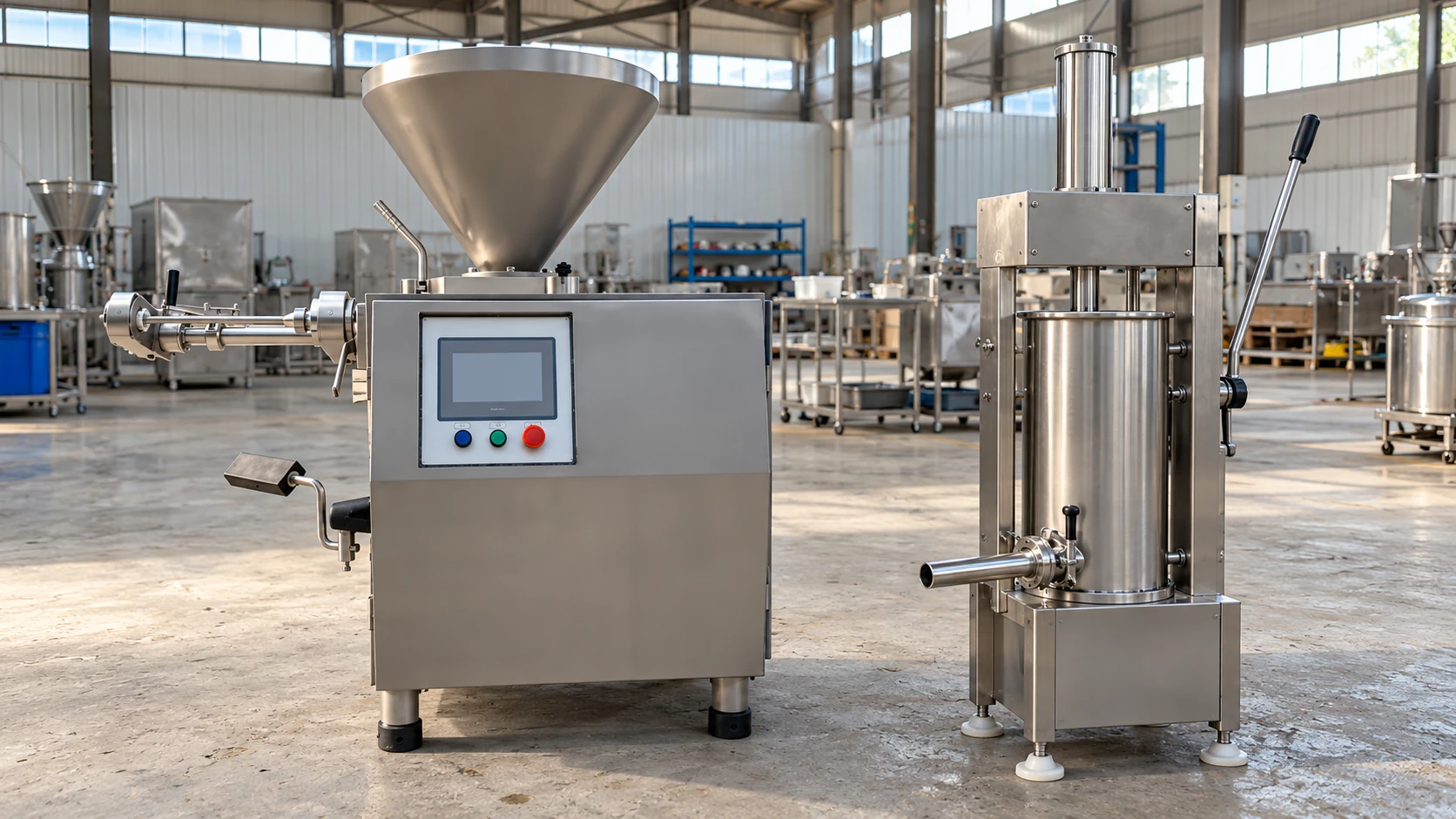
Direct Answer
Choose a batch hydraulic piston stuffer when production is organized around manageable batches, straightforward filling and frequent manual changeovers. Evaluate a continuous vacuum filler when reduced entrained air, repeatable metering, uninterrupted hopper feeding or direct linking and clipping integration are important. Confirm the decision with representative product and casing trials, because formulation, temperature, particle size, casing stretch and downstream timing can change the result.
First clarify what the two machine names describe
A useful vacuum vs hydraulic sausage filler comparison begins with terminology. A hydraulic sausage stuffer commonly means a piston machine: the operator loads a cylinder, a hydraulic system advances the piston, and the product exits through a horn. The machine works in batches because the cylinder must be opened and refilled. The hydraulic system describes how the piston is driven.
A vacuum sausage filler normally uses an open hopper, a feed system and a metering pump. Product can be added while the machine runs, and a vacuum system removes part of the entrained air as the product enters the feed path. Depending on configuration, the filler can deliver a continuous flow or measured portions and can communicate with linking, clipping, forming or depositing equipment.
The labels are not perfect opposites. Some continuous vacuum fillers use hydraulic power for part of their drive, while some piston machines add portioning or twisting accessories. Ask every supplier to identify the feed principle, drive system, vacuum stage, portion-control method and included downstream devices. This prevents a quotation title from hiding two substantially different scopes.
Decide from the production rhythm, not headline capacity
A piston stuffer stops when its cylinder is empty. That pause may be acceptable in a workshop producing short campaigns, several recipes or hand-linked products. The real rhythm includes opening the cylinder, loading the next batch, closing it safely, restarting, managing the remaining product and changing the horn or casing. For a compact team, that predictable batch routine can be practical.
A continuous vacuum filler can be kept supplied through its hopper and may suit a line that needs steadier feed into a linker or clipper. However, the filler cannot create line output by itself. Hopper loading, casing changes, clip reels, hanging, thermal processing, packing and sanitation can still become the constraint. Compare sustained good-product output over a representative run, not only the largest catalogue figure.
Write down the required average kilograms per hour, peak demand, shift length, number of product changes, available operators and expected campaign size. Then map the slowest upstream and downstream steps. A lower-output machine that matches the complete line can be more useful than a faster filler that repeatedly waits for casing, closure or cooking capacity.
Treat air management as a product objective
Vacuum filling is commonly evaluated when visible air pockets, inconsistent density or a porous cut face are concerns. Removing entrained air during feed can help create a denser and more uniform mass, but the effect depends on the formulation and the machine setup. Air may already enter during grinding, bowl cutting, mixing, transfer or manual loading, so the filler is only one part of the control plan.
Do not convert an air-removal claim into an automatic shelf-life or food-safety promise. Shelf life also depends on raw-material quality, temperature control, formulation, microbiology, cooking or fermentation, cooling, package integrity and the validated storage system. Define the observable defect you want to reduce and agree how samples will be compared.
A hydraulic piston stuffer can still make acceptable products when the mixture is prepared and loaded carefully and the application does not require a continuous vacuum stage. For an informed decision, cut representative finished samples, compare visible voids and density, and observe whether loading practice introduces repeatable variation between the beginning and end of each cylinder.
Separate portion control from finished-piece accuracy
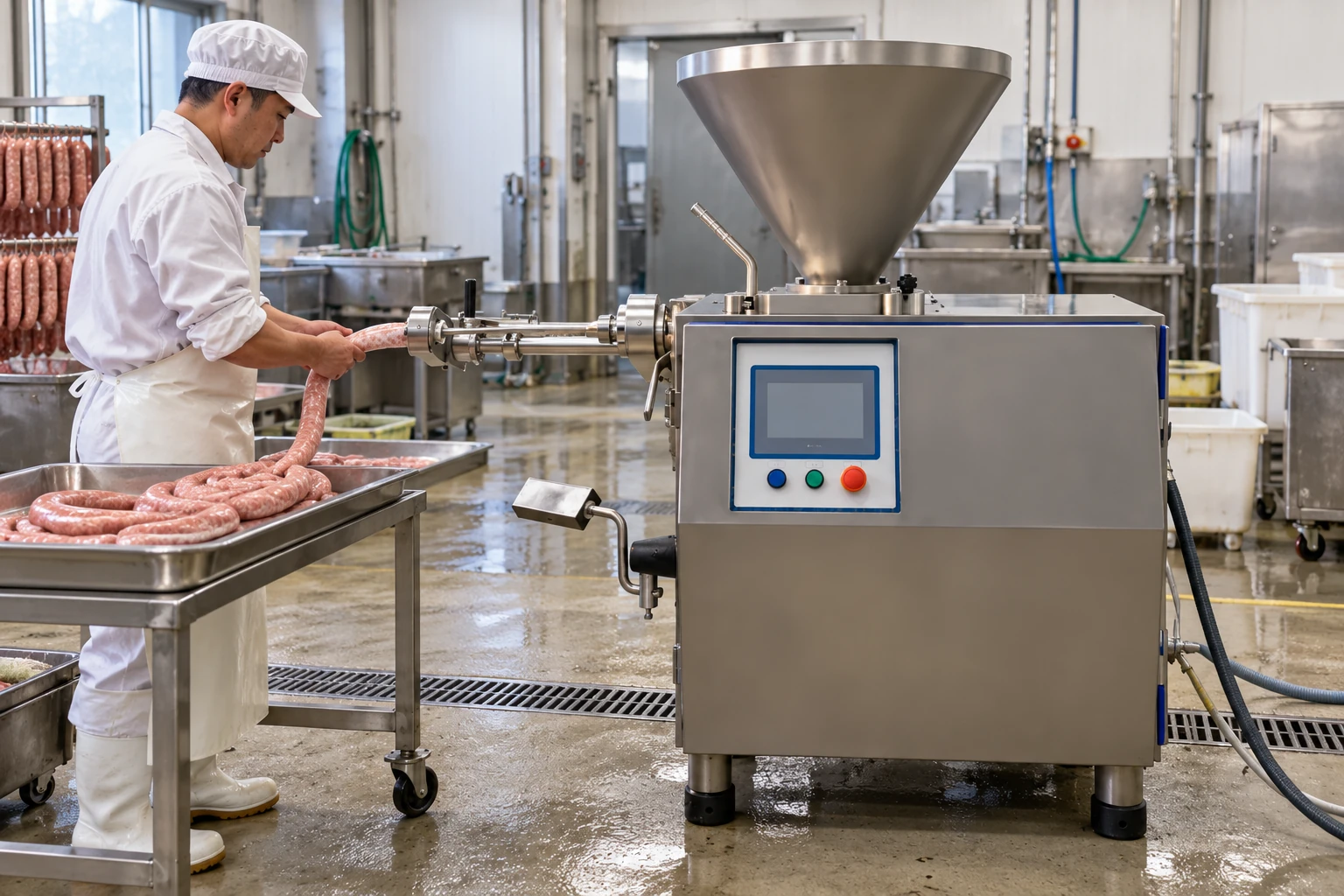
A metering pump can move a repeatable volume, but the saleable portion is produced by the complete system. Product density, temperature, pump fill, pressure, casing diameter and stretch, casing brake setting, horn selection, link separation and clip timing can all change the final weight or length. The first and last portions of a run may also behave differently from steady-state production.
Hydraulic piston machines are often operator-controlled, although some systems can add a dosing valve or twisting and portioning device. Their suitability depends on the tolerance the product and pack format require. If sausages are later grouped to a declared pack weight, record individual variation and pack giveaway rather than judging appearance alone.
For either machine, create a trial sheet that records target weight, sample count, average, spread, casing calibre, product temperature, horn, pressure or speed settings and rejected pieces. A supplier demonstration without these conditions cannot establish the accuracy your factory will obtain.
Match the feed system to product behavior
Fine emulsions, coarse minced mixtures, cold masses and products containing visible particles do not feed in the same way. A pump or feed element that handles a smooth batter gently may respond differently to a dry, stiff or chunky formulation. Excessive shear can change particle definition, while poor hopper feed can introduce gaps and irregular portions.
Send the supplier the real formulation category, maximum particle size, product temperature range, expected viscosity or firmness, inclusions and batch variation. Photographs are useful, but a representative sample trial is stronger evidence when the behavior is uncertain. The trial should use normal production material rather than a specially softened demonstration batch.
The relevant question is not whether one technology handles every difficult product. It is whether the proposed machine, feed element, pressure range, hopper arrangement and outlet can process your product without unacceptable smearing, separation, trapped air or damage. Those commitments belong in the approved quotation and test record.
Define casing, horn and closure as one interface
Natural, collagen, cellulose, fibrous and plastic casings can require different horns, brakes, handling methods and closure equipment. Provide the casing supplier, material, nominal calibre, usable length, shirred-stick format where applicable and the planned finished length or weight. Also identify how often the operator will change casings and what happens to product during the change.
A vacuum filler is often chosen as the metering center of a linking or clipping line, but compatibility must be engineered. Confirm mechanical connection, control signals, emergency-stop behavior, portion command, casing brake, discharge height and the speed range that both machines can sustain. A high filler rate is irrelevant when the closure device cannot receive the product cleanly.
A hydraulic stuffer may feed a separate twister or clipper, or it may support manual linking. That can be an efficient arrangement for the right volume and labor model. Ask whether the accessory is included, which casing range it supports and how portioning performance changes across products rather than assuming the horn alone defines compatibility.
Compare changeover and product loss
Short campaigns make changeover performance important. A piston cylinder can be straightforward to empty and reload, but residual product around the piston, outlet and horn still needs control. A continuous filler has more feed components and seals, yet a well-designed machine may offer organized disassembly and programmed product changes. The actual time depends on configuration and factory procedure.
During a trial, weigh or estimate recoverable and unrecoverable product at start-up, recipe change and shutdown. Record how much material is needed before portions stabilize, how operators clear the feed path and whether mixed product must be downgraded. These losses can matter more than a small difference in nominal speed when the plant changes recipes several times per shift.
Ask the supplier to demonstrate the real changeover sequence with the proposed accessories. Include safe isolation, removal tools, part-handling carts, seal inspection and restart checks. A short video of a clean showroom machine is not a substitute for timing the complete routine after actual product has been processed.
Evaluate cleaning access and verification
Hygiene cannot be inferred from stainless-steel appearance. Review every food-contact route: hopper or cylinder, feed element or piston, seals, pump chambers, outlet, horn, casing brake and connected equipment. Identify which parts are removable, their weight, where they will be washed and dried, and whether tools are required. Look for areas that can trap residue or cleaning solution.
A piston machine may have fewer product-path components, while a vacuum filler may require more disassembly around the feed pump and vacuum path. That general difference does not prove that one particular model is easier to sanitize. Accessibility, surface condition, drainability, instructions, part design and the factory's validated cleaning procedure determine the practical result.
Time a full clean and inspection using the expected crew. Confirm safe isolation, chemical compatibility and the method used to verify cleanliness. Include reassembly checks and pre-operation inspection, because an incorrectly installed seal or feed part can create both hygiene and performance problems.
Plan utilities, footprint and operator handling
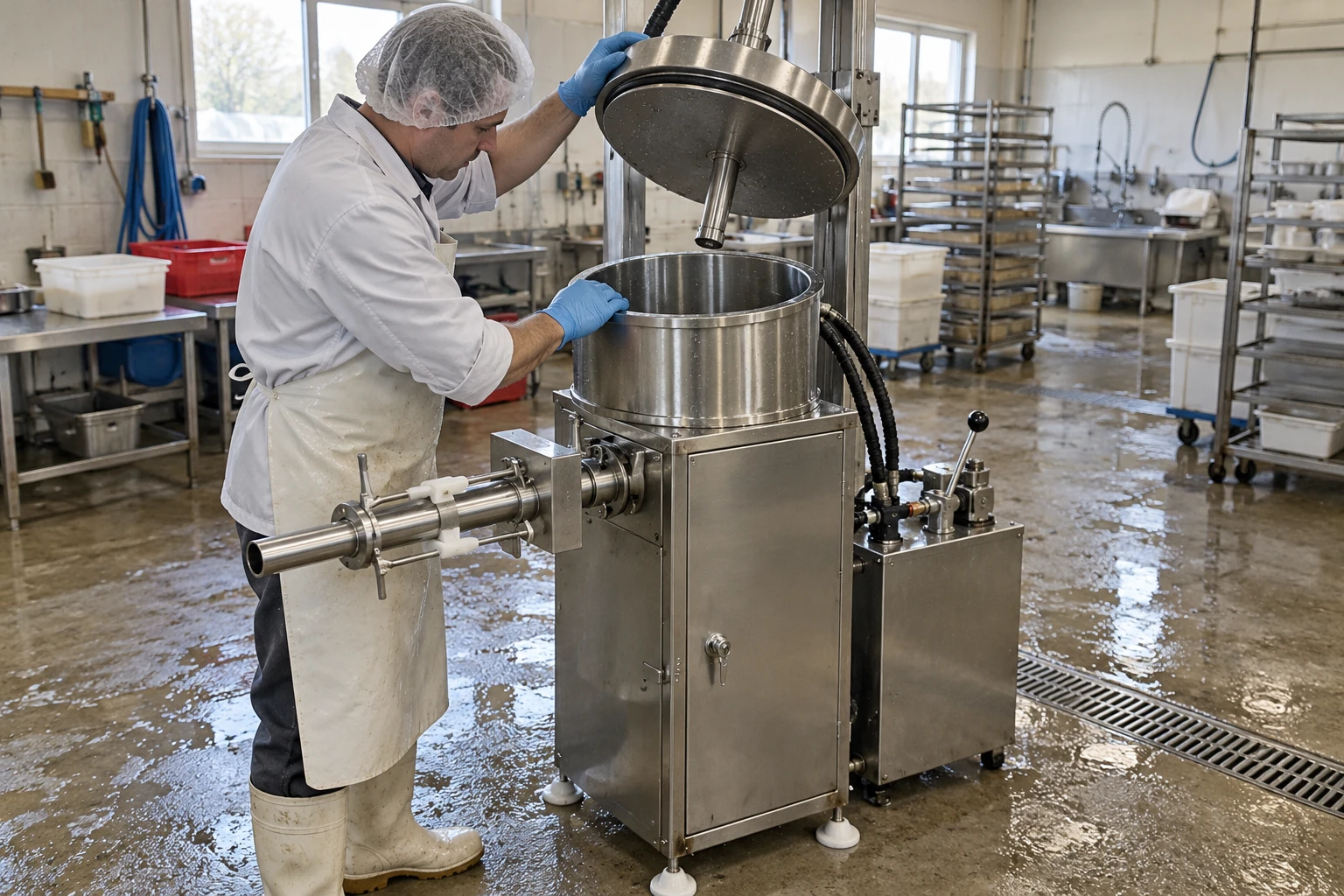
Provide the destination voltage, frequency and available electrical service. A hydraulic piston stuffer may use a compact hydraulic power unit, while a continuous vacuum filler can add a vacuum pump, controls, feed drive and interfaces. Confirm compressed air, water and drainage requirements only from the proposed configuration rather than from a similar machine.
Layout drawings should show hopper or cylinder loading height, doors and panels, horn direction, casing position, product carts, lifting aids, operator stance and space for removed parts. A machine can fit inside the room but still be difficult to load, clean or service. Check delivery access, floor condition, drainage and the route used by ingredients and finished product.
Operator work is part of capacity. Note who loads product, controls casing tension, handles filled sausages, replaces clips and responds to alarms. If a hopper loader or platform is proposed, include it in the scope and safety review. Do not assume that automation at the filler removes labor from the rest of the line.
Compare maintenance and technical support
Hydraulic piston equipment brings seals, cylinder surfaces, oil, hoses, valves and a power unit into the maintenance plan. Continuous vacuum filling adds the vacuum system, feed pump or screws, seals, controls and often more change parts. Wear depends on product, operating hours, cleaning practice and settings, so a generic statement that one technology is maintenance-free is not credible.
Request a preventive-maintenance schedule, lubrication and oil requirements, seal and wear-part list, recommended stock for the first operating period and expected tools. Ask which parts are available locally, which require international shipment and what remote diagnostic support is possible. The documentation should match the exact model and installed options.
For a fair cost comparison, include cleaning labor, changeover loss, casing and product giveaway, expected wear parts, training, utilities and downtime risk. Purchase price is only one line. LACA should quote the selected machine and accessories after the process duty is defined rather than publish a universal price that ignores configuration.
Use a decision matrix before requesting quotations
The table below is a screening tool, not a substitute for a material trial. Mark each criterion as required, preferred or not relevant, then send the same brief to every supplier. This keeps the comparison focused on your process instead of letting each quotation redefine the project.
Where the answer is uncertain, state the uncertainty openly. A supplier can recommend a test, request a sample or offer an option. Unknown information should not be replaced with an assumed casing range, portion accuracy or output promise.
| Decision factor | Batch hydraulic piston stuffer | Continuous vacuum filler | Evidence to request |
|---|---|---|---|
| Production rhythm | Cylinder loaded and refilled by batch | Hopper can be supplied during operation | Timed run including refill and casing changes |
| Air-management objective | Depends strongly on preparation and loading | Vacuum stage can reduce entrained air | Cut-face and density comparison on real product |
| Portioning | Operator or accessory dependent | Metering and line controls may be integrated | Sample weight and length data with conditions |
| Line interface | Manual handling or separate accessory is common | Often configured for linking or clipping | Mechanical and control interface drawing |
| Changeover | Batch cylinder, piston, outlet and horn | Hopper, feed system, pump, outlet and accessories | Full cleaning and restart demonstration |
| Best fit | Shorter campaigns and straightforward batch work | Steady production needing metering or integration | Representative trial and complete line balance |
Run a representative acceptance trial
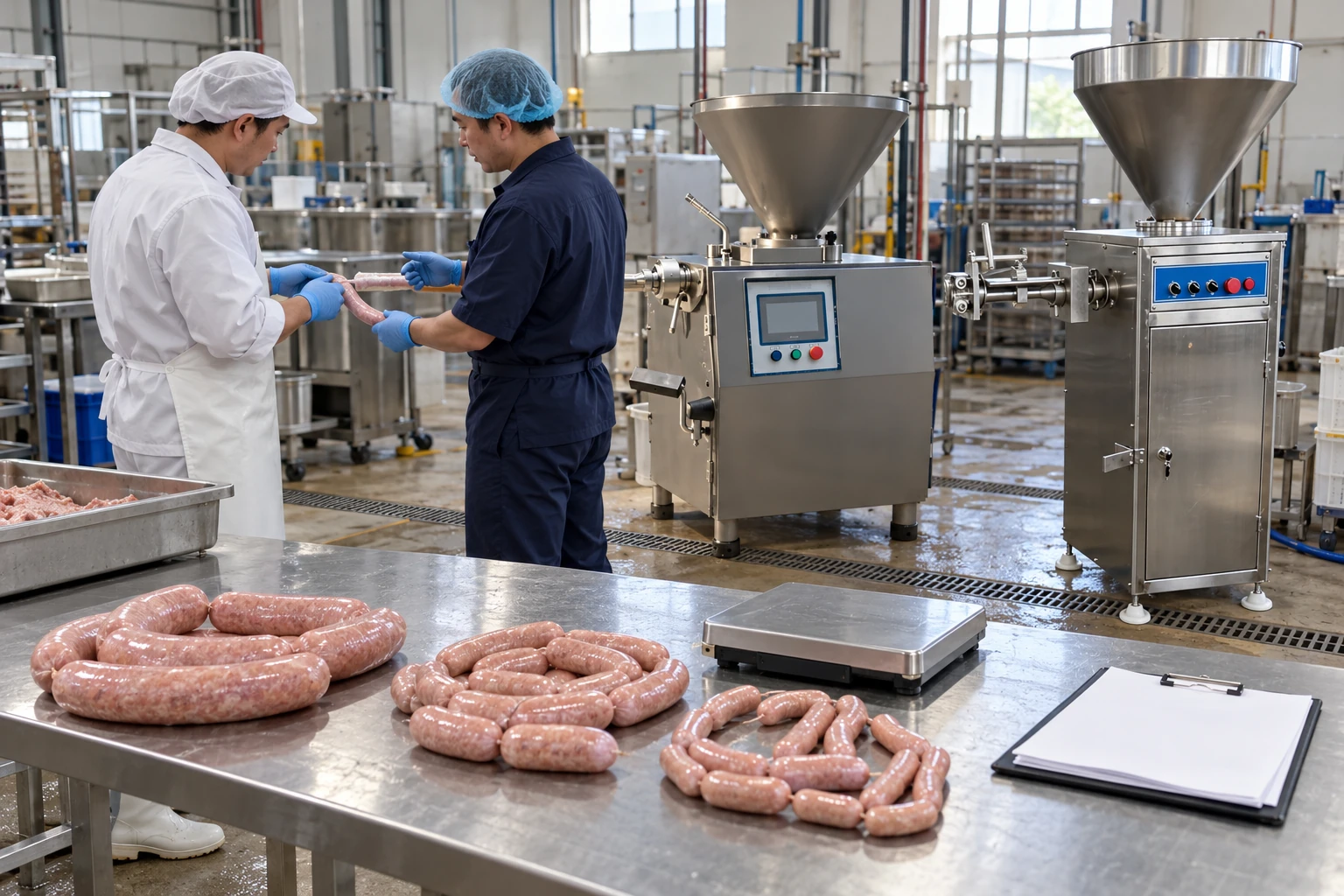
Supply normal production material, the intended casing and any planned linking or clipping equipment. Record formulation version, material temperature, particle size, batch age, casing specification and ambient conditions. Use enough product to observe start-up, steady running, a casing change and shutdown rather than accepting only a few attractive samples.
Agree measurable outcomes before the test: acceptable portion range, visible air pockets, casing damage, product smear, line stops, changeover time, cleaning access and recoverable loss. Keep original data and photographs. If a criterion cannot be tested at the supplier's factory, identify who will verify it during commissioning and what happens if the result is outside the agreed range.
Review the LACA vacuum sausage stuffer for a project that needs vacuum filling and line integration, or compare the LACA sausage stuffer when a simpler filling arrangement may fit. The product pages provide the discussion starting point; the approved quotation and trial record must define the final machine.
Send an RFQ that makes the comparison possible
A useful request includes the product type, formulation category, particle size, temperature, casing type and calibre, target portion, required hourly and shift output, number of recipes, changeover frequency and downstream closure method. Add photographs, sample availability, destination voltage, compressed-air information, layout dimensions and the planned operator count.
Ask each supplier to identify the feed principle, vacuum function, portion-control scope, included horns and casing devices, linker or clipper interface, safety devices, cleaning sequence, spare parts, documentation, installation boundary and acceptance method. Separate standard supply from options. If price is important, request the same delivery term and service scope so the totals are comparable.
Processors can explore meat processing machinery to understand adjacent line stages, then send your trial brief to LACA with the information already available. A complete brief allows the technical discussion to focus on remaining risks instead of guessing from a single product name.
Choose the process architecture that fits the factory
The final choice is not a contest between old and new technology. A hydraulic piston stuffer can be a sensible tool for defined batch work, while a continuous vacuum filler can support steadier metering and more integrated production. Either one can disappoint when the product, casing, labor model or downstream machine is outside the conditions used to select it.
Make the decision in this order: define the finished sausage, characterize the incoming mass, map the complete line rhythm, identify the air and portion-control objectives, confirm casing and closure interfaces, time changeover and cleaning, then compare support and total operating impact. Finish with a representative trial and a quotation that repeats the agreed scope.
This sequence turns the vacuum vs hydraulic sausage filler question into a controlled engineering and purchasing decision. It also creates a traceable basis for commissioning, operator training and later performance review without promising that one machine type is universally superior.
Frequently Asked Questions
Is a vacuum sausage filler always more accurate than a hydraulic stuffer?
No. A vacuum filler may provide metered portions, but finished accuracy also depends on product density, settings, casing behavior, linking or clipping and operating conditions. Compare sample data from the proposed configuration.
Does vacuum filling automatically extend sausage shelf life?
No. Reduced entrained air may support a denser product, but shelf life depends on the complete validated formulation, hygiene, thermal or fermentation process, cooling, packaging and storage system.
Can a hydraulic sausage stuffer connect to a linker or clipper?
Some piston stuffers can use portioning, twisting or closure accessories. Confirm the mechanical connection, control method, casing range and achievable production rhythm for the exact machines.
Which filler is better for frequent product changes?
It depends on batch size, residual product, disassembly, cleaning and restart time. Ask for a timed changeover with representative product instead of judging the number of components from a brochure.
What should be tested before buying a sausage filler?
Test normal product and casing through start-up, steady production, casing change and shutdown. Record portion results, visible voids, casing damage, line stops, loss, changeover and cleaning access.
What information does LACA need for a filler quotation?
Send product and casing details, target portions and output, production schedule, downstream equipment, utilities, layout, destination and sample availability. LACA can then identify the configuration and remaining test points.
Continue Your Research
Tell LACA about your project
Share your material, required output, capacity, destination and any project details available. LACA will use them to begin a focused equipment discussion.