Process & Equipment Guide
How Does a Meat Bone Separator Work?
A meat bone separator does more than push material through a screen. Stable feeding, controlled compression, the selected screen, outlet restriction, temperature management and verification of both outlet streams determine whether the process matches the factory's product and compliance requirements.
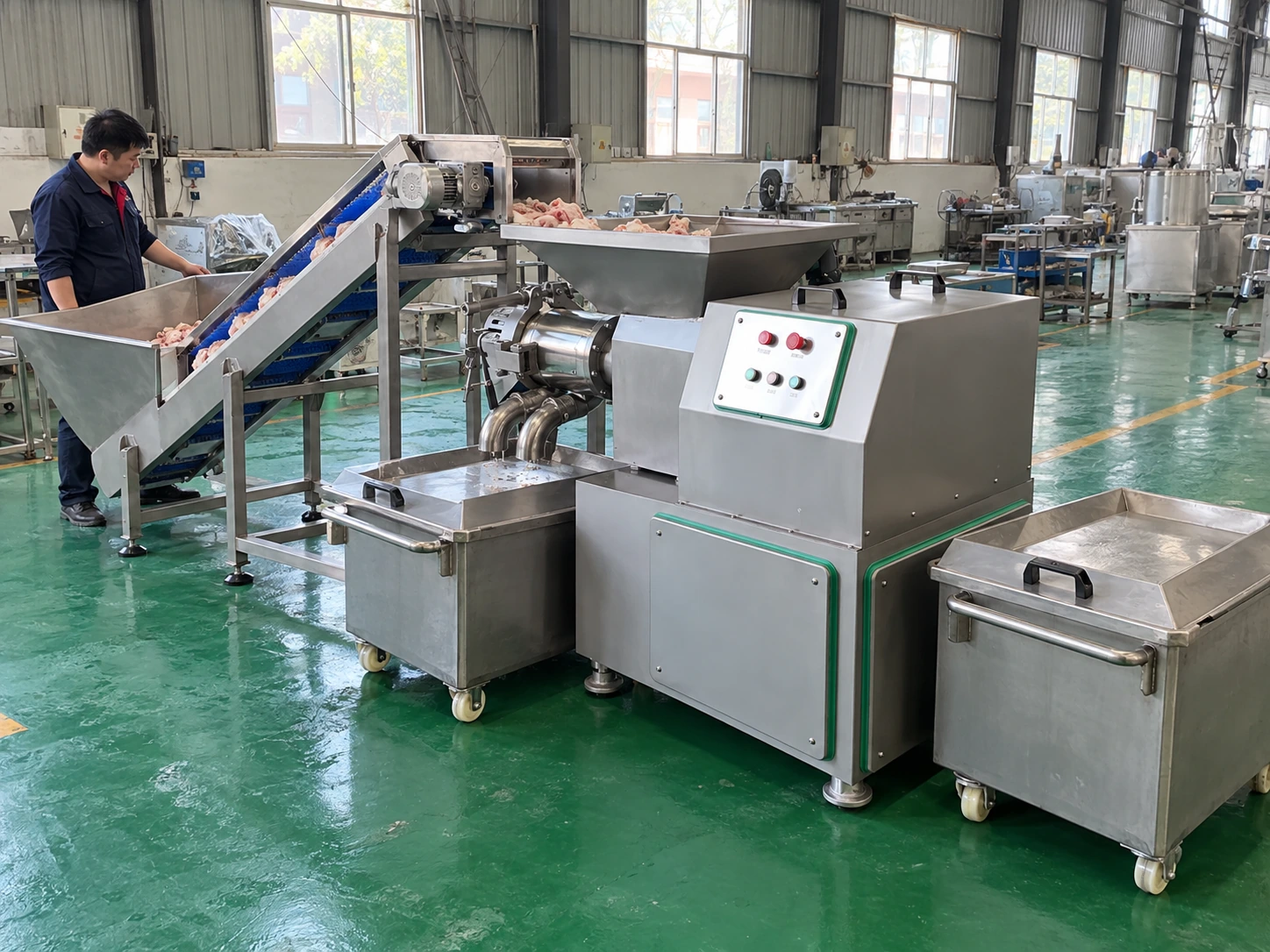
Direct Answer
A screw-and-screen meat bone separator feeds suitable bone-bearing raw material into a separation head. A rotating screw moves and compresses the material against a slotted or perforated screen. Softer tissue that can pass the openings leaves through the recovered-product outlet, while harder bone-rich residue continues to a separate restricted discharge. The actual result depends on the raw material, preparation, feed rate, screen, restriction setting, temperature and machine condition, so buyers should confirm it with a timed mass-balance trial and quality checks on both streams.
What the machine is actually separating
A meat bone separator is intended for suitable bone-bearing material after primary cutting or deboning, such as selected poultry frames or other raw materials approved for the machine and destination market. The machine uses the different behavior of softer tissue and harder material under controlled mechanical pressure. It does not recognize meat and bone as a camera or sensor would; separation occurs because the two material fractions respond differently to the screw, screen and outlet restriction.
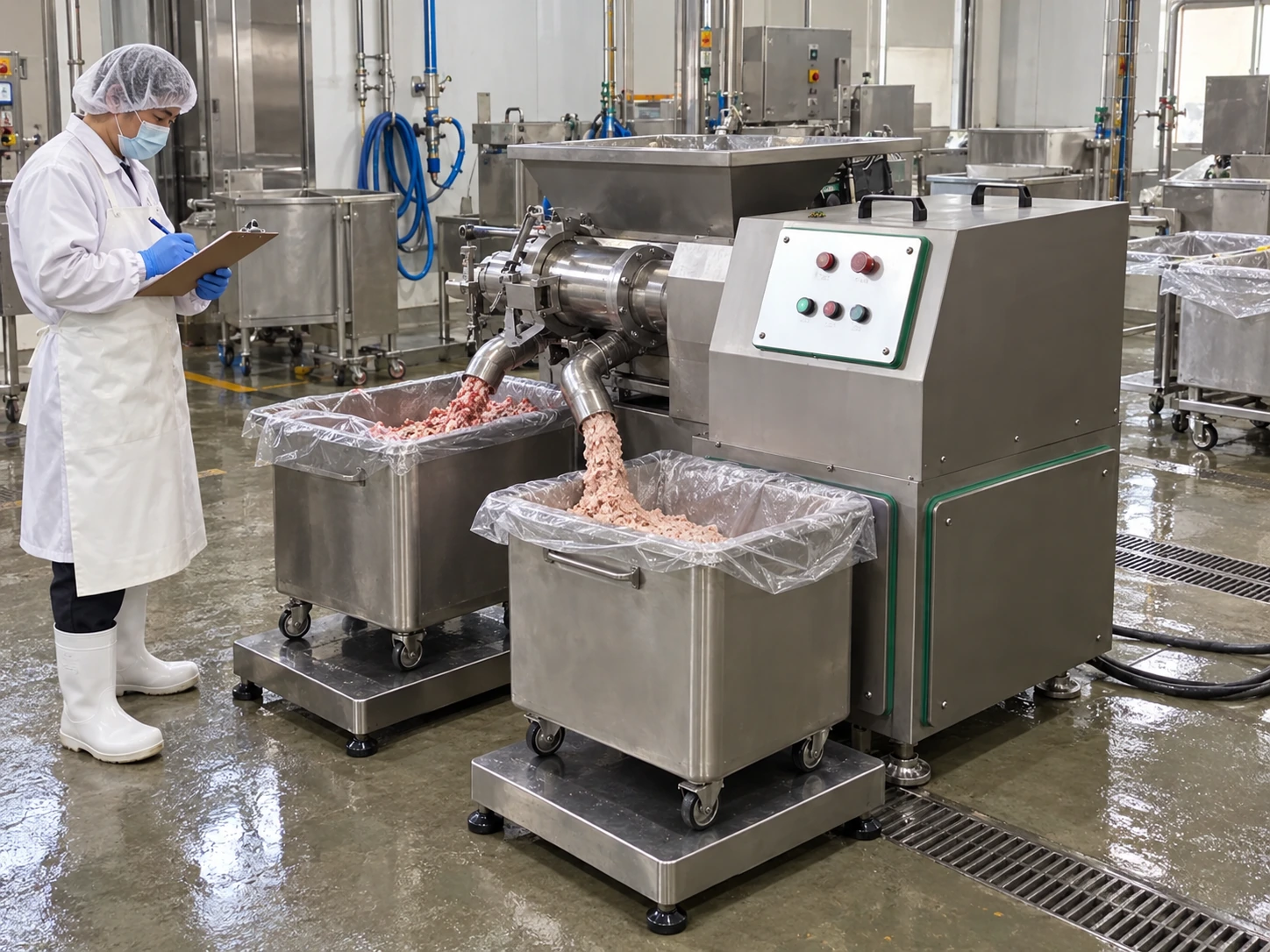
The process creates two streams. Softer material passes through openings in the screen and is collected as the recovered stream. Bone-rich residue, together with material that does not pass the screen, moves to a separate discharge. Both streams matter. A visually attractive recovered product does not prove an acceptable process if too much soft tissue remains in the residue, while a very dry residue does not prove success if the recovered stream fails the buyer's texture, composition or legal requirements.
This equipment is not a meat grinder. A grinder reduces particle size by cutting material through a plate. It is also not automatically the same as a belt separator, desinewer or hydraulic recovery press. Buyers should identify the actual raw material, process objective and equipment principle before comparing results or using broad terms such as deboner.
The complete separation process in one line
The simplest process description is: receive approved raw material, control its condition, feed it evenly, move it through the screw-and-screen head, collect the recovered soft-tissue stream, discharge the bone-rich residue, then cool or transfer both streams according to the factory plan. Every verb in that sequence needs a defined method and owner.
Upstream equipment may include cutting, size reduction, inspection, chilled holding and a metered conveyor. Downstream equipment may include covered collection, pumping, grinding, mixing, chilling or another product-specific step. The separator cannot compensate for uncontrolled raw-material temperature, large foreign objects, irregular feed surges or a downstream bin that stops the outlet.
A useful process flow drawing shows the machine boundary, feed elevation, two outlet paths, collection or transfer method, operator positions, cleaning route and control interlocks. This drawing is more informative than a standalone machine photo because it shows whether the complete flow can remain stable and hygienic.
Step 1: Define and prepare the raw material
Begin with the species, anatomical source, amount of residual tissue, bone hardness, piece dimensions, skin or fat content, storage history and temperature. A name such as chicken frame is not a complete specification. Frames from different cutting operations may contain different proportions of neck, back, ribs, cartilage, skin and remaining muscle, and those differences can change feeding behavior and the balance between the two outlets.
Preparation must match the confirmed machine configuration. Some applications can accept larger pieces, while others require controlled pre-sizing. The decision should follow a supplier review and representative test rather than an assumption that smaller pieces are always better. Excessive grinding can change the material, increase fines and make it harder to interpret the separator's real performance.
Before a trial, remove prohibited or unsuitable material according to the factory's food-safety program and destination rules. Record the normal condition and credible variation. A successful run with specially selected material is not evidence that mixed daily production will behave the same way.
Step 2: Feed the separator at a stable rate
The hopper should receive material at a rate the screw can take without long empty periods or sudden overloading. Hand feeding may be practical for a short test, but an operating line often benefits from a metered conveyor or other controlled transfer. The objective is a repeatable feed condition, not simply keeping the hopper full.
Surges can change the pressure inside the head, motor load, residence time and the appearance of both streams. Starved feeding can also create unstable results because the separation head is not working under the same material load. During a test, record feed weight and time, and note any interruption rather than averaging it away.
Operators should stay clear of the hopper and all moving parts while the machine is running. Guards, interlocks, safe tools and written procedures must match the installed equipment. Product should never be pushed into the feed zone by hand.
Step 3: The screw creates forward movement and pressure
Inside the separation head, the rotating screw conveys material forward. The geometry of the screw and head reduces available space and develops mechanical pressure as material approaches the screen and restricted discharge. The exact geometry is machine-specific, but the general purpose is to maintain controlled movement while presenting the material to the separation surface.
Pressure is not one independent number that can be copied from another factory. It changes with raw-material composition, feed rate, screen resistance, outlet restriction, wear and temperature. A setting that works for one poultry frame may produce a different texture or residue condition with another source material.
During commissioning, buyers should observe motor load, feed stability, vibration, unusual noise and any tendency for material to bridge or block. These observations help distinguish a process-setting issue from inconsistent preparation or a mechanical problem. They should be recorded with the product results, not treated as separate maintenance notes.
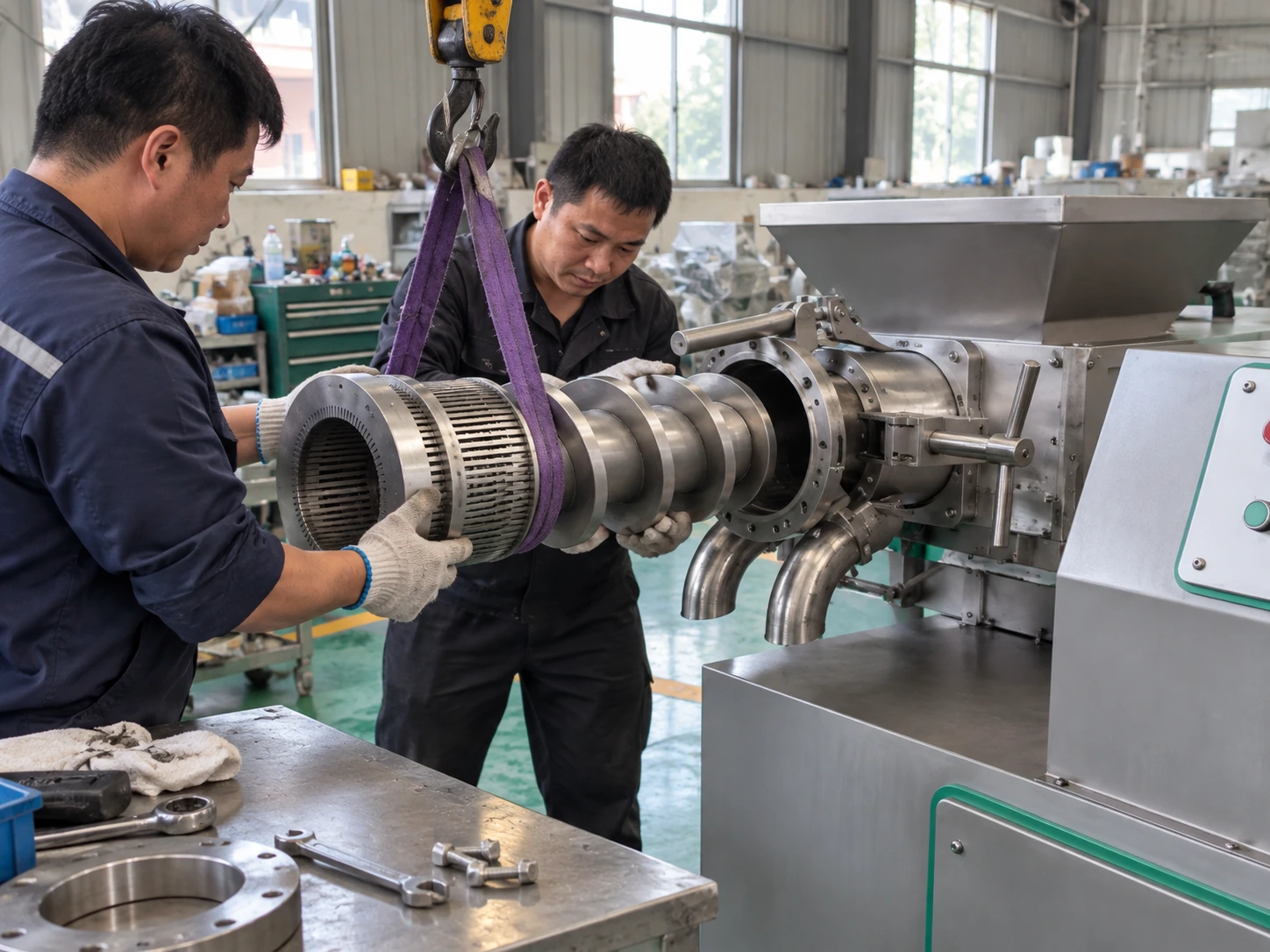
Step 4: Softer tissue passes through the screen
As the screw moves material along the screen, softer tissue capable of flowing through the slots or perforations enters the outside collection space and leaves through the recovered-product outlet. Harder particles that cannot pass remain within the main material path. This difference in resistance is the core of the screw-and-screen separation principle.
Screen opening influences what can pass, but it does not work alone. Screen condition, open area, head geometry, feed pressure, material temperature and composition all influence the output. A nominal opening size therefore cannot guarantee texture, calcium, bone-particle distribution or recovery for an unknown material.
Inspect the recovered stream over time, not only at the first discharge. Look for changes in color, consistency, visible hard particles, free liquid and temperature. Collect representative samples after the machine reaches stable operation and label them by time and setting for internal analysis.
Step 5: Bone-rich residue leaves through the restriction outlet
Material that does not pass through the screen continues toward the residue outlet. A restriction or adjustment at this end helps control resistance in the separation head. Increasing restriction may change the amount of soft material removed, but it can also increase load, temperature rise, screen blockage and the risk that unwanted hard material affects the recovered stream.
The residue should be collected safely and inspected as a process output. Note its temperature, structure, retained soft tissue, moisture and consistency across the run. A large change in residue appearance may indicate variation in feed, a setting change, screen condition or unstable machine load.
Do not judge the process from residue dryness alone. The acceptable balance depends on the intended recovered product, the factory's specifications and destination requirements. The aim is not the maximum possible extraction at any cost; it is a controlled result that meets the agreed quality and compliance boundaries.
Why screen opening and outlet restriction must be tuned together
A finer screen can limit larger particles, but it also increases resistance and may reduce flow or increase pressure for the same feed. A more open screen can change texture and the range of material passing through. Changing the restriction alters the pressure environment acting on that screen. For this reason, screen selection and outlet adjustment should be treated as one configuration.
Make one controlled change at a time during trials. Record the installed screen identity, restriction position or adjustment method, feed condition and stable operating period. If several variables change together, a good or bad result cannot be traced to one cause.
The approved production setup should be documented with photographs or part numbers where available. Operators need a repeatable reference for reassembly after cleaning, and the quality team needs to know which configuration produced the validated samples.
Why inlet temperature and temperature rise matter
Mechanical work and friction can raise product temperature. The amount of change depends on raw material, feed stability, pressure, residence time, equipment condition and starting temperature. Temperature can also influence how fat and soft tissue flow through the screen, so it is both a product-control variable and a clue to process stability.
Measure representative inlet material and recovered output with the factory's approved method. Record time and sampling location. A single surface reading from one piece before start-up cannot describe the full lot, and a reading taken long after collection may include warming or cooling outside the machine.
The processor remains responsible for time-temperature control, hygienic handling and any validated limits. The equipment supplier can discuss mechanical configuration, but should not replace the factory's food-safety plan or destination-market requirements with a generic temperature promise.
How to measure a trial with a mass balance
A mass balance is the clearest way to describe a separator trial. Weigh the prepared feed placed into the test, the recovered stream and the bone-rich residue on the same calibrated basis. Record material left in the hopper or machine, spillage, samples removed and any other loss so the totals can be reconciled.
Use a stable timed period rather than including every start-up and shutdown irregularity in one average. Start-up material can be recorded separately. Repeat the test when normal raw-material variation is important, and do not turn one short run into a universal production claim.
Recovery percentage is meaningful only when the calculation, sampling period and product-quality criteria are stated. A higher recovered weight may reflect more moisture, fat, skin or unwanted particles rather than more usable meat. Pair the mass balance with quality checks on both outlets.
| Trial record | What to capture | Why it matters |
|---|---|---|
| Incoming material | Species, source, preparation, temperature and weighed feed | Defines the exact duty tested |
| Machine setup | Screen identity, restriction setting, feed method and operating time | Makes the result repeatable |
| Recovered stream | Weight, temperature, appearance and representative samples | Connects recovery to usable quality |
| Residue stream | Weight, structure, retained soft tissue and samples | Shows what did not pass the screen |
| Reconciliation | Hold-up, samples, spillage and unexplained difference | Prevents an inflated or incomplete calculation |
| Operating observations | Load, interruptions, noise, vibration and cleaning time | Links product results to machine behavior |
What to test in the recovered stream
The recovered stream should be evaluated against its intended downstream use and market category. Possible checks include appearance, consistency, temperature, composition, calcium or bone-particle criteria, microbiological controls and functional behavior in the next process. The correct list and limits come from the processor's specification and applicable rules, not from a universal separator checklist.
Take samples that represent stable production and preserve them correctly for the chosen tests. If different settings are compared, keep each sample traceable to the exact screen, restriction, feed lot, time and operator record. Avoid choosing only the smoothest-looking sample from a variable run.
Run a downstream trial when the recovered material will enter an emulsion, sausage, formed product or pet-food process. Laboratory values and visual inspection are important, but the material must also behave acceptably in the factory's actual formulation and thermal process.
What to inspect in the bone-rich residue
Residue inspection helps explain where the mass went and whether the process is stable. Compare retained soft tissue, moisture, particle structure and consistency between the beginning, middle and end of the stable run. Keep a sample when the buyer needs laboratory or rendering evaluation.
An unusually wet residue may indicate a different feed composition or an open setting, while a very dry or fragmented residue may accompany more aggressive separation. These are diagnostic observations, not automatic pass or fail rules. They must be interpreted together with the recovered-stream specification and machine behavior.
Define how residue will be collected, identified, stored and transferred after production. It is a real output with handling, hygiene and disposal or further-processing responsibilities. An overflowing residue cart can stop the process or create contamination even when the separator itself is running correctly.
How the separator connects to the rest of the line
Upstream, the factory may need cutting, inspection, controlled size reduction, chilling and metered feeding. If a grinder is used, its purpose and particle-size effect must be defined separately; review the LACA industrial frozen meat grinder as a different machine rather than assuming it performs separation.
Downstream, the recovered stream may need covered collection, pumping, grinding, mixing or immediate chilling. The residue stream needs its own cart or conveyor. Specify outlet height, pipe or chute geometry, bin volume, transfer time and the response when either destination is full.
Controls should coordinate feeding and separation so a stop does not continue loading the hopper or trap product for an uncontrolled period. The layout should reserve safe access for head opening, component removal, cleaning and maintenance, not only the footprint shown in a sales drawing.
Cleaning and reassembly are part of the process
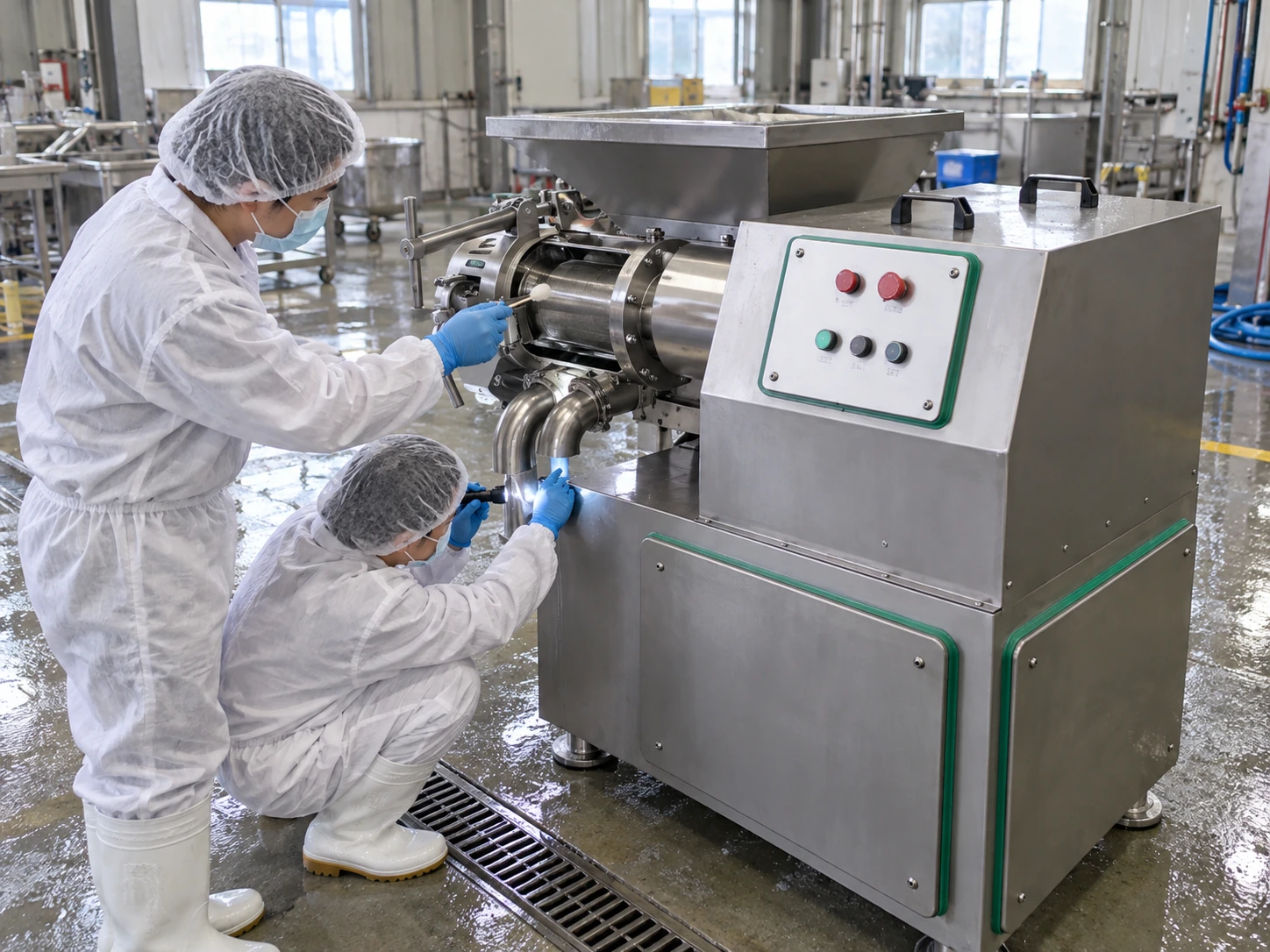
At the end of production, the screw, screen, head, seals, outlets and nearby product-contact surfaces require cleaning and inspection according to the machine instructions and the factory sanitation program. The exact sequence should include safe isolation, controlled opening, supported removal of heavy components, gross soil removal, washing, inspection, reassembly and pre-operation checks.
Time the complete sequence during acceptance. A claim of easy cleaning is useful only when operators can perform the work safely, reach retained material, inspect slots and seals, protect electrical parts and restore the approved configuration without damaging components.
Post-cleaning verification may include visual inspection and the factory's approved hygiene checks. Reassembly should confirm screen identity, component orientation, seal condition, fastener security, guards and interlocks. A clean machine assembled with the wrong screen or restriction setting will not reproduce the validated process.
A factory acceptance test for a meat bone separator
Begin the factory acceptance test with machine identity, supplied components, drawings, guards, controls, motor direction, emergency stops and interlocks. Run the machine without product only for the checks that a no-load test can prove. Product performance requires representative material and an agreed trial plan.
During the product run, capture feed condition, operating time, setup, load observations, temperature, both outlet weights, samples and cleaning time. Agree in advance which results are measured at the supplier's factory and which require confirmation after installation with final utilities and production staff.
Record open points, deviations and the exact configuration approved for shipment. The acceptance report should identify the machine, screen and included spare parts, and it should avoid converting a trial result into a guarantee for raw materials that were not tested.
Regulatory classification is market-specific
Mechanically separated meat, mechanically separated poultry, mechanically recovered meat and related terms are not interchangeable in every jurisdiction. Classification can depend on species, source material, process, fibre-structure change, composition and intended use. Some markets also distinguish mechanical separation from other recovery or trimming processes.
The machine supplier cannot determine the legal name of the buyer's product from equipment model alone. Before purchase, the processor should confirm permitted raw materials, establishment requirements, labelling, testing, traceability and downstream use with the competent authority and qualified specialists in the destination market.
Share those confirmed boundaries with the supplier before trials. They affect the output specification, test plan and configuration discussion. This guide explains equipment operation; it is not a regulatory approval or a finished-product formulation.
Send LACA a process brief before requesting a model
Use the LACA meat bone separator page to review the current equipment family, then send a process brief rather than only asking for capacity. Include species and anatomical source, photos, piece dimensions, storage temperature, daily volume, required feed rate, intended recovered-product use, available utilities, line layout and destination country.
State whether representative material can be tested and which evidence will decide acceptance. Useful requests include a timed mass balance, inlet and outlet temperatures, samples from both streams, cleaning demonstration, utility list, spare-parts proposal and drawings showing the line interfaces.
If the commercial scope is also being compared, read the LACA meat bone separator price guide separately. It explains quotation inclusions and lifetime-cost questions without mixing them into this working-principle article. Explore LACA meat processing machinery for adjacent equipment, then send the final material and project data through the LACA contact page.
The machine works only as well as the test conditions are defined
A screw-and-screen separator works by moving bone-bearing material through a controlled pressure zone, allowing softer tissue to pass the screen and directing harder residue to another outlet. That principle is simple, but industrial results depend on a connected set of conditions that must be measured and repeated.
Define the material first, stabilize feeding, document screen and restriction, measure temperature, weigh both streams, test the recovered output, inspect the residue, verify cleaning and connect the machine safely to upstream and downstream equipment. These steps turn a demonstration into useful engineering evidence.
The best selection is not the machine that produces the largest number in one short run. It is the configuration that repeatedly meets the factory's product, hygiene, operating and market requirements with traceable evidence.
Frequently Asked Questions
Is a meat bone separator the same as a meat grinder?
No. A grinder cuts material to reduce particle size. A meat bone separator uses mechanical pressure and a screen to create a recovered soft-tissue stream and a separate bone-rich residue stream. The machines may be connected in one process, but they perform different jobs.
What passes through the screen in a meat bone separator?
Softer material capable of flowing through the selected openings passes into the recovered stream, while harder material remains in the main path and exits as residue. The exact composition must be verified for the raw material and settings used.
Does a smaller screen opening always produce better separated meat?
No. Screen opening interacts with open area, feed, pressure, outlet restriction, temperature and material condition. A finer screen may increase resistance or change flow, so the configuration must be tested against the required product specification.
How should a factory measure meat recovery during a trial?
Weigh the prepared feed, recovered stream and bone-rich residue over a stable timed period. Record hold-up, samples and losses, then pair the mass balance with temperature and quality checks on both outlet streams.
Does mechanically separated meat have the same legal name in every country?
No. Classification and permitted use can vary by species, source material, process and destination rules. The processor should confirm the product name, labelling, testing and use with the competent authority and qualified specialists.
What information does LACA need to discuss a meat bone separator?
Send the species and anatomical source, material photos, piece size, temperature, required feed rate, intended recovered-product use, production schedule, utilities, layout, destination country and sample availability.
Continue Your Research
Tell LACA about your project
Share your material, required output, capacity, destination and any project details available. LACA will use them to begin a focused equipment discussion.